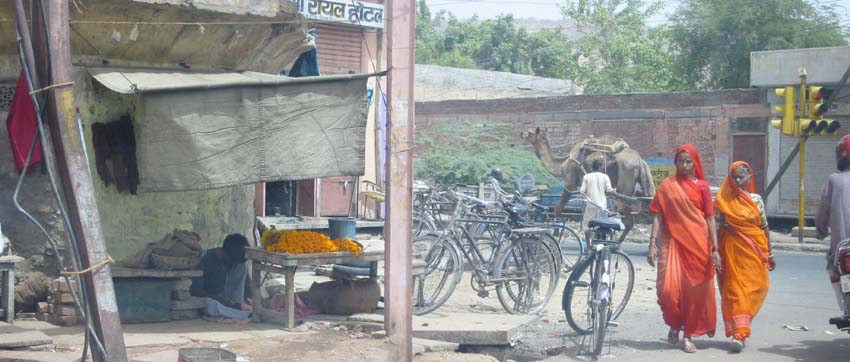
We arrived in Jaipur at night. Although this is known as the pink city, at night the colour of the buildings is obscured by the throngs of people. Sanju calmy winds his way through hectic roundabouts and acute angled road junctions. Along the middle of the roads we glimpse, through subtle candlelight, shrines which have been designed for drive by worship; presumably when traffic moves so slowly that people have time to pay for garlands of marigold to leave for the next car to cover with the sand that drifts constantly across the road.
back to top
The Jaipur Palace Hotel
Massive lit up cinema posters, multistory bazaars, and a chaotic streem of traffic light up the streets until Sanju takes two small roads that lack any lighting at all. He slowly maneuvers the car around a huge pile of sand, perhaps from construction or maybe from the work of the wind, and pulls into a tiny driveway to the Jaipur Palace hotel. He has the coupons from Javed that are used to pay for this hotel so at no time do we discover how much this hotel would actually cost. Any concerns we had that Javed had found us the cheapest of hotels are assuaged the moment we step out of the car. Two men appear in red turbans and matching uniforms of white with a print of short random angled lines of red and green. They carry our rucksacks uncomfortably, pretending they are suitcases, up three flights of stairs to the stunning suite they have selected for us.
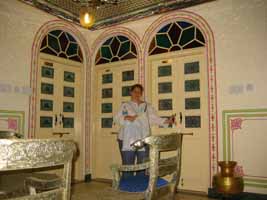 Our Jaipur Suite
In the morning a peacock caws on the roof next to our window and we discover why the bathroom is entirely tiled: there is a drain for the shower in the floor and all the water flows directly into it. We are making a relatively early start and, after we finish with breakfast served by one of about 8 uniformed staff that we see this morning, Sanju is waiting across the road in the car. We have not seen any other guests in the hotel and it appears that the ratio of workers to guests is seriously imbalanced. We wonder briefly where Sanju stayed the previous night, but he preepmts questions by asking where we wish to go. Our plan is to see the Amber Fort in the outskirts of the city, but Sanju convinces us to stop at the Hawa Mahal before leaving the city for the day.
back to top
The Hawa Mahal - the Wind Palace
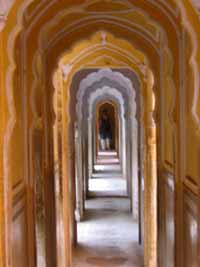 Arches in the Hawa Mahal
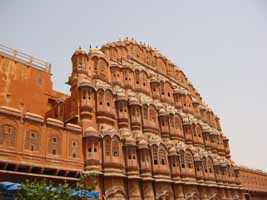 Hawa Mahal
We are soon driving through the city toward the Amber Fort. We see our first elephants by the side of the road and also see an increased use of the camel as a beast of burden. We are used to seeing pictures of the camel in single file, walking through deserts, so they seem out of character pulling carts behind them. There is also the fact that they don't appear to move any slower pulling huge loads than they do with their regular waking pace. It is as if these massive weights mean nothing to the muscles that are the length of a 10 year old child.
back to top
The Amber Fort
From a distance it is difficult to see where the mountian ends and the Amber Fort begins. Built with the same stone of the mountain on which it rests it is perfectly camoflaged and the rounded architectural details make it less harsh on the landscape. The heat haze also helps in the mirage that makes this fort appear much smaller than its interior reveals.
We pay the 400 rupees required for an elephant ride and climb aboard the mammoth creature. The elephant ride from the road to the top of the mountain will prove to be one of the most lengthy and jerky trips we take in our entire trip to India - despite this, Julie pulls off a very impressive Lauren Bacal look of elegance during a less than flattering means of transport.
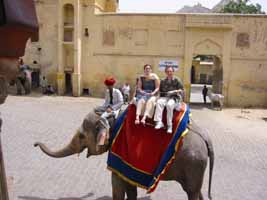
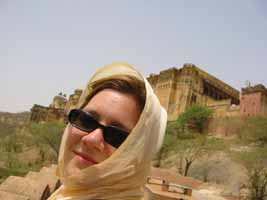
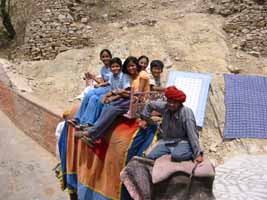
When we are brought into the main courtyard on the back of the elephant, the immense size of the gates is reduced since we sit so close to the archway. A staircase is required in the dismount from the elephant and. only once we are on the ground, we can fully appreciate the scale of the architecture.
There is an incredible maze of narrow interconnected passageways that can take you all over the fort. There is no need for secret passageways since you can lose your way by attempting to follow any main passageway. The passages can lead into rooms with no exits, or can lead you to one of the mainy courtyards or elegant rooms that are built throughout the complex. Not only is there a Hawa Mahal inside the Amber Fort, there is also a Palace of Mirrors. In one courtyard there is so much water and greenery in the garden that one forgets there is desert all around. We see a monsoon runoff system in which the water from the monsoons would be collected as a waterfall that cascades down a wide trench on the wall and floor in the room below to be deposited into the garden of the courtyard.
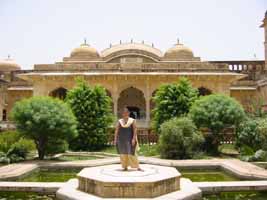
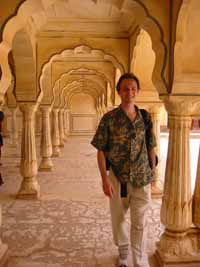
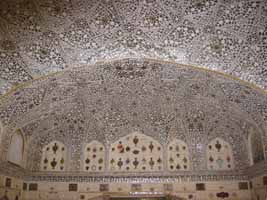
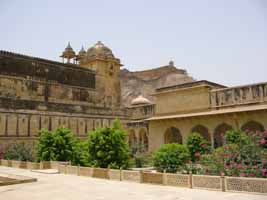
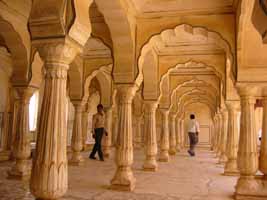
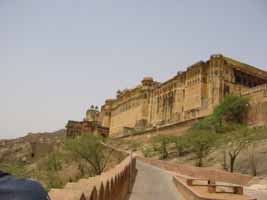
Looking out at the world from the palace the remains of a great wall that traversed the spines of the surrounding mountain range can still be seen. At times the wall has collapsed but, on the whole, the space between watchtowers is much the same as it was in the 16th century. It seems lonely. Cut off from the world beyond the valley. That loneliness may have felt more acute in the Palace of Mirrors where you might have only your own broken reflection for company.
back to top
The City Palace
On the trip back to the city we stop off for lunch in an empty restaurant. After a large meal Julie takes a rest in the hotel and Marcus heads out for a look at the City Palace and the amazing Jaipur Observatory. Once again our decision to hire the driver was a great benefit. Knowing exactly how to get from one place to another leaves us the ability to sit back and observe the city by day. The streets are packed and, unlike Delhi where people urinate wherever they wish, Jaipur has created a number of very public urinals. The urinals are not at all enclosed and are elevated from the ground so that the rear end of all the men is closer to the eye and nose. The drainage system is simply a hole that connects to the ditch that runs under the pavement.
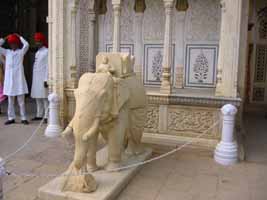
The walk around the City Palace is quite brief. There are three museums of textiles, armory, and art and a bizare pair of the largest silver jugs in the world. There are some lovely carvings around the palace and inside the art museum there are some amazing books that are narrow rectangles read in landcape format. Written mostly in sanskrit these books are not bound in the traditional western way. There are two solid pieces of wood, one serves as a flat base, the other is an ornately painted or carved top cover. The pages often have a central hole, or two holes, which fit around spindles of wood that protrude from the flat base to secure the pages in place. Each page has been ornately designed and text is not written on both sides of the paper. The museums are dark and, as with many of these institutions in India, I get the sense that the best examples of the art work are no longer in the home country. They have been taken elsewhere to preserve or perhaps to keep history outside of this country.
back to top
The Jaipur Observatory
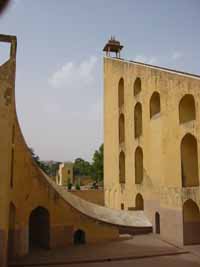
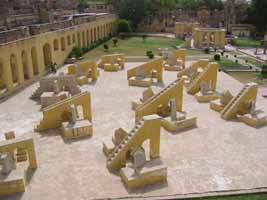
The Observatory next door to the City Palace is astounding. Although there are 5 observatories in India, including one in Delhi, the one at Jaipur is the largest of them all. These are physical observatories, massive mathematical constructs that pinpoint the light from the sun at particular times of the year. Surrounding the Shashthantra Yantra, which determines the local latitude by means of a massive shadow casting tower, there are a series of smaller buildings that signify the 12 astrological star signs.
|